1. What does a crash rating actually certify?
A crash rating certifies one specific event: a test vehicle of a defined class and mass, driven at a declared speed and angle, into the barrier installed the way it was tested, and the distance that vehicle still travelled past the barrier. Every number in the code is part of the claim. Change the vehicle, the speed, the angle or the foundation, and the rated performance no longer applies.
That narrowness is the point. The classification lets a specifier compare two products that were tested the same way, and lets a buyer rule out a product whose test does not match the threat assessment for the site. It does not mean the barrier will stop a heavier vehicle, a faster vehicle, or the same vehicle on a different slab.
So the first question about a crash-rated barrier is not whether it is rated, but which report the rating comes from. Four standards decide most current procurement: BSI PAS 68 in the United Kingdom, ISO IWA 14-1 internationally, ASTM F2656 in North America, and ISO 22343-1 as the newest global framework. Older schemes such as CWA 16221 and the US Department of State K-ratings still appear on drawings, which is where most of the confusion starts.
2. How do you read a PAS 68 rating code?
PAS 68 is the British publicly available specification, first published in 2007 and revised in 2010 and 2013. It was developed with the UK national infrastructure bodies and remains the reference in UK, Middle East and Commonwealth tenders. The code is read left to right, and a typical one looks like this: V/7500(N2)/48/90:0.0.
- The leading V means a vehicle-borne impact test, as opposed to a pendulum or simulated test.
- 7,500 is the test mass in kilograms: the vehicle was ballasted to that figure when it hit the barrier.
- N2 in brackets is the vehicle category, which fixes the body style, gross weight and structure that was used.
- 48 is the impact speed in km/h, and 90 is the impact angle in degrees, where 90 is a square-on hit.
- 0.0 is the vehicle penetration distance in metres, measured from the rear, defensive face of the barrier.
- Where a second figure appears after the penetration, it is the major debris dispersion distance in metres, which PAS 68 carries inside the rating.
3. Why does the measurement datum matter so much?
Because penetration in PAS 68 is measured from the face the defender stands behind, the barrier own depth is already excluded from the number: the vehicle has to travel through the structure before it crosses the rear face. The same physical test therefore produces a smaller figure under PAS 68 than under a standard that starts measuring at the impact face.
This is the single most common error in tender comparisons. A PAS 68 result of 0.0 m means the vehicle did not cross the rear face of the barrier, not that it stopped dead on the line. When a supplier puts a PAS 68 figure next to an ASTM or IWA figure in the same table, the two numbers are not measuring to the same point, and the table invites the wrong conclusion.
4. How does ASTM F2656 differ from the European codes?
ASTM F2656 is the North American vehicle impact test standard. It replaced the US Department of State SD-STD-02.01 rating system, which is why old drawings still show K4, K8 and K12: those are Department of State classifications from a withdrawn document, not ASTM results. The current edition is F2656/F2656M-20.
In F2656 the rating is a two-part code. A medium-duty truck of about 15,000 lb, roughly 6,800 kg, is driven at 30, 40 or 50 mph, written M30, M40 and M50 and corresponding to roughly 48, 64 and 80 km/h. Penetration is then reported as a band rather than an exact figure: P1 for under one metre, P2 for one to seven metres, P3 for seven to thirty metres.
Two consequences follow. The bands are coarse compared with a European exact figure, so M50-P1 tells a specifier only that nothing passed the barrier by more than a metre. And penetration in F2656 is measured from the front, impact face, which aligns it methodologically with IWA 14-1 rather than with PAS 68.
Where a legacy document asks for K12, the figure normally quoted in current language is M50-P1, with K8 around M40 and K4 around M30. Treat that correspondence as a starting point for a quotation, not as a certificate: the K tests and the F2656 tests are not the same protocol, and a product with a K rating has not automatically been tested to F2656.
5. What does IWA 14-1 add, and where does ISO 22343-1 fit?
IWA 14-1 is the International Workshop Agreement published by ISO in 2013 to harmonise the national schemes into one method. It grades nine vehicle categories, covers impact speeds from 16 to 112 km/h, states penetration from the front face, and reports major debris in the test report rather than inside the code. IWA 14-2 is the companion document on selection and installation, in the same way that PAS 69 supports PAS 68.
It has since been superseded as the current framework by ISO 22343-1:2023, which brings debris of 2 kg and above into the rating itself and caps the penetration figure at 25 m. Products tested to PAS 68 or IWA 14-1 keep their ratings — standards are withdrawn, published results are not — but a tender written today usually names ISO 22343-1 or IWA 14-1.
For a buyer outside the United Kingdom the practical rule is short: check which standard the tender names, and do not assume that an attractive number on a datasheet was produced under that standard.
6. PAS 68, IWA 14-1 and ASTM F2656 side by side
The differences that decide a comparison are not cosmetic. They are the items below, and each one changes what a rating is allowed to claim.
- Test vehicle and mass: PAS 68 and IWA 14-1 use European cab-over truck classes with a ballasted test mass; F2656 uses a North American medium-duty truck at about 6,800 kg. Vehicle structures crumple differently, so the same barrier can score differently.
- Impact speed: PAS 68 and IWA 14-1 span 16 to 112 km/h; F2656 offers the 30, 40 and 50 mph steps only.
- Penetration datum: PAS 68 measures from the rear face, IWA 14-1 and F2656 from the front face. This is the difference that most often inflates a cross-standard comparison.
- Penetration format: exact metres in PAS 68 and IWA 14-1, bands of P1, P2 and P3 in F2656.
- Debris accounting: inside the PAS 68 code, in the report for IWA 14-1 and F2656, and inside the rating for ISO 22343-1 at 2 kg and above.
- Installation guidance: PAS 69, IWA 14-2 and the F2656 site-specific option. None of it is part of the classification code, which is where most real-site failures begin.
7. Why can a PAS 68 rating not be converted into an ASTM rating?
Because the standards do not measure the same thing, from the same point, with the same vehicle. National guidance on hostile vehicle mitigation is explicit that a rating must not be duplicated or adjusted to provide equivalence with another standard, and that is not caution for its own sake.
Three mechanical reasons sit behind it. The datum differs, so an identical test yields a friendlier number under PAS 68 than under F2656 or IWA 14-1. The vehicle categories differ, and a European cab-over heavy truck is not interchangeable with a North American medium-duty truck even when the masses look close. And the test-mass tolerances do not always overlap, which means a product physically cannot be tested once and written up under both classes.
The consequence for a tender is blunt. If the specification says PAS 68 V/7500(N3)/80/90:0.0, a product carrying ASTM F2656 M50-P1 is not an alternative until an engineer has assessed it in writing. It is a different claim, not a translation of the same one.
8. Does the rating still apply after installation?
A rating belongs to the configuration that was tested, foundation included. PAS 68 is supported by PAS 69 on selection and installation, IWA 14-1 by IWA 14-2, and F2656 defines the ground conditions of the test unless a site-specific installation has been agreed and recorded. A barrier dropped onto a thin slab over a service duct has not been tested.
In practice the foundation is where the claim is won or lost: excavation depth, concrete class and reinforcement, the surrounding soil, drainage, and the anchor pattern of a fixed bollard all change how the barrier transfers impact load into the ground. Ask for the foundation drawing the test house accepted, and have the civil design signed off by an engineer who works on hostile vehicle mitigation, not only on general civil works.
9. What should you ask a supplier for, in writing?
A quote that answers these seven points can be checked by a consultant, an insurer or a tender committee without a second round of questions. A quote that answers none of them is a marketing claim with a price attached.
- The standard and its edition, not just the phrase crash rated.
- The full classification code, decoded into vehicle class, test mass, impact speed, impact angle, penetration and debris distance.
- The test report itself, with the test house name, its accreditation and the date of the test.
- Confirmation that the model, height, section length and finish being quoted are the configuration that was tested.
- The foundation or anchorage drawing accepted at test, and what changes if the site slab differs from it.
- Whether the rating covers a single impact or repeated impacts, because a single-impact rating is not a repeated-attack rating.
- Where debris dispersion was measured, and the clearance behind the barrier that the figure implies for your site layout.
10. How does SECUGUARD publish its own vehicle barrier figures?
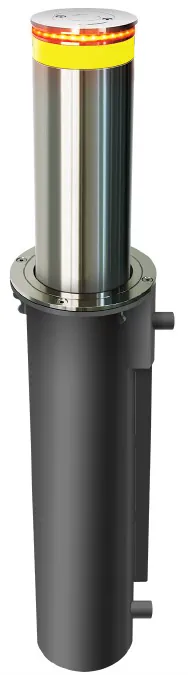
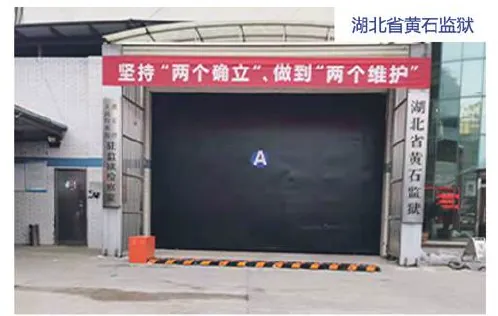
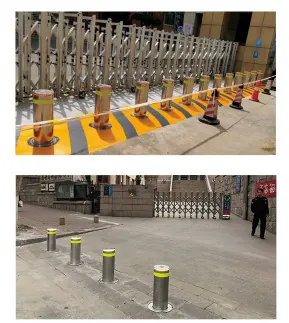
SECUGUARD publishes the figure the factory has actually tested, rather than borrowing a classification it does not hold. The hydraulic road blockers are rated so that a 6.8 t truck at 80 km/h cannot break through. The automatic hydraulic bollards are published at 120 t dynamic and 80 t static load in MPS crash tests, with a 1.5 to 3.5 s rise time and an IP68 protection rating.
If your tender names PAS 68, IWA 14-1, ASTM F2656 or ISO 22343-1, put that in the enquiry instead of leaving it to the datasheet. We will quote the test documentation that exists for the model, and where a specific classification has not been tested we will say so rather than convert a number from another standard. For the hardware itself, start from the hydraulic road blockers or the fixed anti-crash bollards and work back to the rating your site actually needs.
hydraulic road blockers · fixed anti-crash bollards · automatic hydraulic bollards
11. Which rating should a new project specify?
Specify against the threat assessment, not against the most impressive code on the market. The vehicle class should match the vehicles that can physically reach the site, the speed should come from a vehicle dynamics assessment of the approach, and the angle should reflect the geometry of the lane rather than a convenient 90 degrees.
Once those three are fixed, name the standard that the local authority, insurer or consultant already accepts. In the United Kingdom and much of the Middle East that is still PAS 68 or IWA 14-1; in North America it is F2656; in a new international specification it is increasingly ISO 22343-1. What must not happen is a tender that asks for one standard and a supplier that answers with another, hoping the numbers look close enough.