1. What does a tyre killer actually do at a checkpoint?
A tyre killer is a lane-mounted spike barrier. Steel blades sit flush with the road so everyday traffic, including container trucks, drives over them without slowing, and the blades rise in about 1 to 2 seconds on command to puncture the tyres of a vehicle that is forcing through.
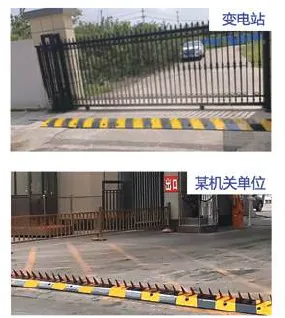
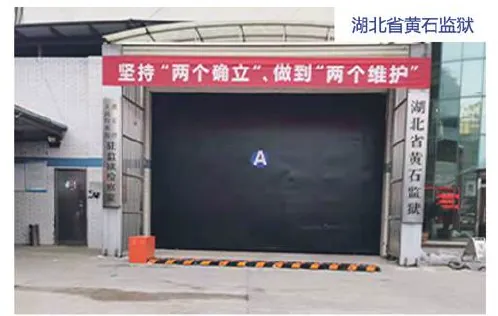
It is a destructive interception device rather than a wall. Instead of resisting the impact it takes away the vehicle the ability to keep driving: once the tyres are punctured the vehicle loses grip and stops within a short distance. That is why tyre killers are fitted where traffic must keep flowing but a one-way rule has to be enforced, at toll plazas, border and police checkpoints, military bases, prison gates, government entrances and factory logistics gates.
The trade-off is built into the design. Because the blades sit under the road surface and stand only 150 mm above it on the SECUGUARD LZYS-A-LF66, the device is nearly invisible to normal traffic and needs far less civil work than a blocker. What it does not do is arrest a heavy vehicle at the point of contact the way a raised steel flap does, so the two are different tools rather than alternatives on price alone.
2. Tyre killer or road blocker: which one should guard the lane?
Both devices close the same lane, and buyers routinely put them in the same tender. The differences that decide the project are the interception principle, the footprint in the road, and what happens to the vehicle that tries to pass.
- Interception principle: a tyre killer drives the blades up into the tyres. A hydraulic road blocker raises a flap 300-600 mm above the road, so the vehicle meets a barrier it cannot roll over.
- Published impact figures: SECUGUARD rates the LZYS-A-LF66 so that a 10 t truck at 80 km/h cannot pass, and rates the hydraulic flap road blocker so that a 6.8 t truck at 80 km/h cannot break through after MPS crash testing. Ask for the test report behind whichever figure your tender quotes.
- Cycle speed: the tyre killer rises and descends in approximately 1-2 s, the hydraulic road blocker in approximately 1.5-3.5 s.
- Road footprint: the tyre killer sits in a shallow trench and stands 150 mm tall when deployed; the blocker needs an embedded foundation and a buried hydraulic power unit, because the raised flap carries the impact load.
- Direction and traffic discipline: bi-directional blade layouts enforce one-way flow and anti-passback, where a vehicle tries to re-enter through an exit lane. A road blocker simply closes the lane in both directions.
- Where each belongs: tyre killers at exits, return lanes, toll lanes and checkpoints where throughput matters; road blockers at the inner perimeter of prisons, airports, nuclear sites and government compounds where the vehicle must not cross the line at all.
3. Is a tyre killer a crash-rated barrier?
The phrase crash rated comes from hostile vehicle mitigation testing. A barrier is struck by a test vehicle of a defined class, mass and speed at a defined angle, and the result is a classification plus a penetration distance. The standards in common use are IWA 14-1:2013, BSI PAS 68, ASTM F2656 and CWA 16221; each has its own vehicle classes and protocol, and a rating under one standard cannot be converted into another.
Spike devices normally sit outside that framework, because the standards assume the barrier arrests the vehicle on impact, while a tyre killer relies on the vehicle travelling further before it stops. So when a supplier advertises a crash rated tyre killer, ask four questions in writing: which standard, which test vehicle class and mass, what impact speed and angle, and what penetration distance was recorded. If the reply is a phrase rather than a report, treat the figure as a design claim, not a certified rating.
Where a consultant, insurer or government tender requires a certified vehicle security barrier, the certified element is normally a bollard or a road blocker. The tyre killer can still be part of the lane layout, but it should not be presented as the certified barrier.
4. Which specifications actually decide performance?
A tyre killer datasheet is short, and almost every figure on it changes what the lane has to look like. These are the items worth arguing about, with the published values for the SECUGUARD LZYS-A-LF66 as the reference point.
- Rise and descent time: 1-2 s on this model. At 20 km/h a vehicle covers 5.6 m each second, so a 2 s rise uses about 11 m of approach distance. Place the loop detector or ANPR trigger with that number rather than by eye.
- Service life: 50 million cycles. On a toll lane cycling tens of thousands of vehicles a day that is a design life in years, so ask whether the figure comes from bench testing or field records, and which parts are expected to wear.
- Load capacity: 80 t static and 120 t+ dynamic on this model, which is what lets container trucks share the lane with cars. Confirm the rating for the lane length and blade layout you actually order.
- Blade geometry: 150 mm blade height, 10-15 mm blade thickness and 12-20 mm panel thickness. Taller, thicker blades puncture run-flat and heavy-truck tyres more reliably, and they need a deeper trench.
- Drive: hydraulic or electromechanical-hydraulic, 220 V and 200 W on this model. Fail-safe behaviour comes with it: emergency descent control keeps the lane usable on power failure, and fail-up is the alternative where security outweighs egress.
- Environmental protection: IP68 for the assembly in the trench, which is the difference between a lane that works after a wet season and one that jams on grit.
- Control: remote and wired operation from a 600 x 350 x 400 mm control box in the guard house, with a defined interface to the lane controller and the site security platform.
5. Buried, surface or bi-directional: which form fits the lane?
The same mechanism is sold in three installation forms. The choice is decided by the road, the traffic pattern and whether the checkpoint is permanent.
- Buried: the mechanism sits in a cast trench with the blades flush to the asphalt. Best for permanent, high-frequency lanes such as toll plazas and checkpoints, and it occupies the least road. It needs civil works, drainage and a power route, so it belongs in the project schedule from the start.
- Surface: the unit mounts on top of the pavement for minimal works. Best for temporary checkpoints, event security and rapid deployment, and it can be relocated to the next site.
- Bi-directional: blades arranged to intercept traffic from either direction, or to enforce a single direction of travel. Choose it for anti-passback lanes and one-way exit control.
6. How do you fit it into a lane that already has inspection and barriers?
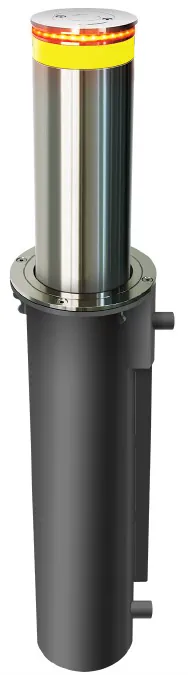
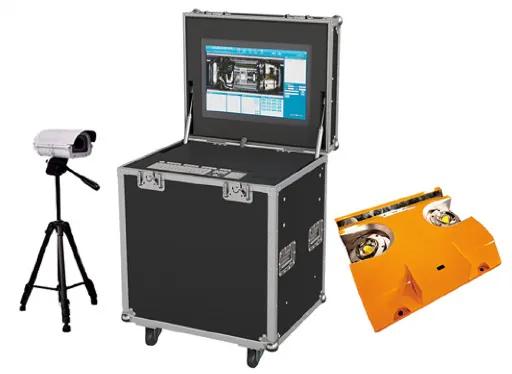
A tyre killer is one layer of a lane, not the whole lane. The layout that works at checkpoints runs in a fixed order: pre-screening with under-vehicle inspection or imaging, then access control with bollards or a barrier gate, then interception with a tyre killer and a road blocker, all reporting to one control platform.
- Trigger the blades from a loop detector or an ANPR camera, with a manual override in the guard house, so the default cycle does not depend on operator reaction time.
- Mark and light the lane before the blades. When an authorised vehicle is punctured by mistake, the first question asked is whether the lane was signposted and the operator trained.
- Put the trench drainage in the civil works package. Blade channels silt up, and grit and ice are the two most common reasons a buried unit jams.
- Agree one emergency mode in writing: which device drops first, on whose authority, and how a fire appliance crosses the lane on a night call-out.
7. What belongs in the datasheet and the quotation?
Ask for the datasheet of the exact model rather than the product family, and check it against the lane you are building: model and drive type, rise and descent time, blade height and thickness, static and dynamic load, IP rating, supply voltage and power draw. Add the impact test report where one is claimed, the trench or foundation drawing with the drainage detail, the cable route and control box position, the interface list for the lane controller, spare blade sets and wear parts, warranty, commissioning, operator training and the export documentation for the shipment.
8. Where does the factory fit into the decision?
Most projects end up ordering both devices once the traffic study is done, because the threat and the everyday traffic pattern rarely match. SECUGUARD builds the tyre killer and the hydraulic flap road blocker as one interception range, the LZYS-A-LF66 in buried, surface and bi-directional forms and the flap blocker with 300-600 mm interception height, so the two can be specified, delivered and integrated as a single lane instead of two purchases from two suppliers.
Send the lane drawing, the vehicle mix and the daily traffic count. The engineering team will say which device in the layout carries the certification your project needs, and send the datasheet, foundation drawing and test report for that exact model.