1. What do the numbers on an X-ray datasheet actually decide?
Tunnel opening decides what fits through the machine, belt speed decides how fast items move, and steel penetration decides how dense an object still shows on the image. Everything else — wire resolution, grayscale depth, zoom and colour tools — only helps the operator read what those three numbers already captured.
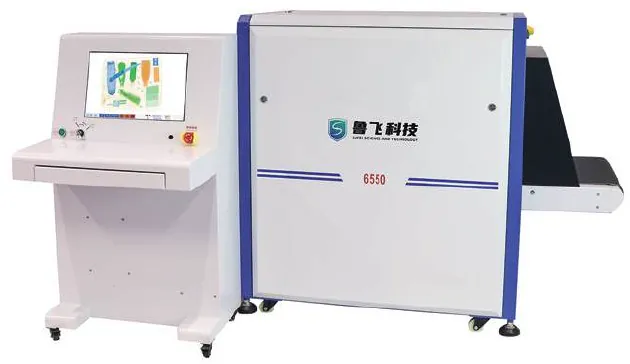
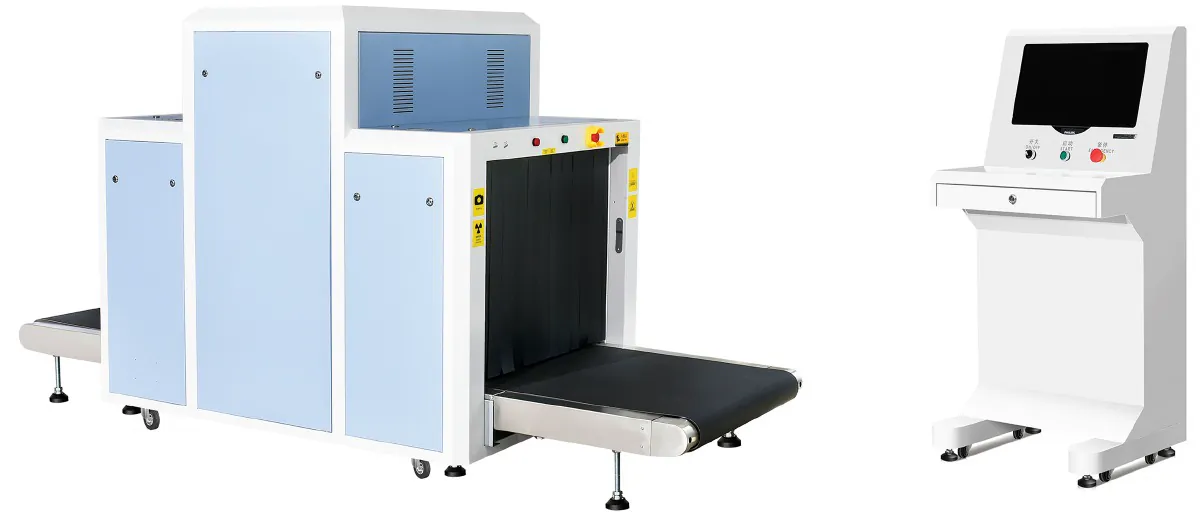
X-ray scanners are sold by tunnel class rather than by a free-form shape, because the opening is the first thing that rules a model in or out. In the SECUGUARD LF series the class is in the model name: LF-5030 for the 5030 tunnel, LF-6550 for the 6550 tunnel, with the belt running 0.22–0.5 m/s and a rated load of 200 kg evenly distributed.
Buyers usually get this backwards. They start from "how much penetration can I buy" and end up paying for beam power they never use, while the queue at the door is limited by something else entirely — the tunnel is too small for the suitcases, or the operator needs more seconds per image than the belt can deliver bags.
2. Which tunnel class fits the bags you actually screen?
Measure the biggest item your screening policy requires through the tunnel, in its natural scanning position, and not the biggest item you can imagine. Then pick the smallest class that passes it with a little clearance — an oversized tunnel costs money, floor space and power, and it slows nothing down.
Both classes are built on the same SECUGUARD platform, so the choice between them is about the opening and the items, not about imaging quality.
- 5030 tunnel (500 × 300 mm class) — cabin bags, backpacks, handbags, laptop bags, mail and courier parcels. This is the default class for office lobbies, courts, stations, stadiums and building entrances.
- 6550 tunnel (650 × 500 mm class) — larger suitcases, hold bags, boxed equipment and bulkier parcels. This is the class to look at when visitors arrive with wheeled luggage or when parcels are consolidated.
- Custom opening — where the parcel mix includes long or flat items that no standard class accepts, the tunnel can be specified per parcel dimensions. Say so at quotation stage, because a custom opening is a factory order and changes the lead time.
- One number that is easy to miss: the load rating. The LF series is rated 200 kg evenly distributed on the belt, so a single heavy crate close to that figure needs to be considered together with how it is loaded, not just whether it physically fits.
3. How many bags per hour can one screening lane clear?
Work it out in two steps, and take the lower of the two results. First the belt: at 0.22 m/s with bags spaced 1 m apart, one lane passes about 790 items an hour; at the top belt speed of 0.5 m/s the same spacing gives about 1,800. That is belt arithmetic, not a manufacturer rating, and it assumes the machine never stops.
Then the operator. A reviewer who needs 3 seconds per image clears roughly 1,200 images an hour, and at 6 seconds per image the same person clears about 600. In practice the second number governs, because the belt keeps moving only while images are being cleared, and every re-scan of an ambiguous bag consumes another slot.
That is why a throughput claim in a brochure should always be read together with the mode it was measured in. Ask the supplier for bags per hour at your item mix and your review staffing, and ask what re-scan rate they assumed, because a lane with a 15% re-scan rate loses more capacity than most buyers budget for.
4. Is 14 mm of steel penetration enough?
Penetration describes how much steel the beam still sees through; resolution describes how fine a detail it can resolve. The SECUGUARD LF series is rated at 14 mm steel plate with a line resolution that resolves a single 0.0787 mm solid copper wire, on a tube running 100–140 kV and 0.4–1.2 mA, both adjustable.
For baggage, parcels, mail, courier consignments and the dense electronics that turn up in laptop bags, that combination is the practical working range: the operator needs to see a thin blade or a detonator wire inside a bag whose walls, frames and batteries are competing for the same image. Penetration without resolution shows you a dark rectangle; resolution without penetration loses the object behind the battery pack.
Where 14 mm is not the right answer is loaded cargo, pallets and vehicles. Those are a different equipment class with a different beam energy, and asking a baggage scanner to do that job ends in a lane that fails its own acceptance test. If your item mix includes both, split it into two lanes instead of buying one machine that compromises on both.
Because penetration and resolution are measured at defined settings, ask for a scan image of a test piece you specify — a folded steel plate, a wire of known diameter, a representative bag from your own flow — rather than a rendered illustration. Contact us for the datasheet of the exact model before you compare figures with another supplier.
5. Single-energy, multi-energy or AI: where should the money go?
Material discrimination is the feature that changes how the operator works. The SECUGUARD baggage scanner uses multi-energy detection with material identification, classifying contents as organic, inorganic or mixed, which is what lets a guard decide "this is food and clothes" or "this is a power tool" without opening the bag. On the LF platform the sensor is an L-shaped photodiode array, 24 BIT, with 4096 grey levels and a 1920 × 1080 display, plus zoom, invert and edge-enhancement tools for the second look.
AI is the next step, and it is bought for a specific reason: image volume. The optional AI image analysis module raises automatic alarms for dangerous goods against a contraband library that can be customised to the site, and the AI image review system carries that further by screening images in the first pass and pushing suspicious ones to a central review desk, so one experienced reviewer covers several machines.
Rule of thumb for a buying committee: buy the tunnel class and belt you need first, material identification second, AI and centralised review third — and only then compare brand names. If your peak is a shift change at a factory gate, AI on a machine with the wrong tunnel still leaves you hand-searching suitcases at the door.
The hardware behind these requirements is on the X-ray security scanner page for the LF-5030 and LF-6550 models; the review-side workflow is on the AI image review system page.
6. What does the site need before the machine arrives?
An X-ray scanner is a fixed installation with a radiation envelope, so the site survey is not optional. These are the items that most often delay commissioning.
- Power: the LF series draws 1.5 kW on 220 VAC (±10%), 50 ±3 Hz. Confirm the circuit is dedicated and that the socket is where the machine will actually stand, not where the drawing says it will.
- Environment: operating range 0–45 °C at 20–95% relative humidity. A covered, ventilated room is the normal home; an open yard in monsoon conditions is not.
- Space and workflow: machine footprint plus the approach and exit side for bags, trolleys and the operator position. The exact dimensions are on the datasheet — contact us for it — because they decide whether the lane fits the lobby before anything is ordered.
- Radiation and local rules: the machine is rated at a leakage dose below 0.09 μGy/h and is film-safe for ISO1600 film, but the room and the operator procedure still have to satisfy your own regulator. Ask for the compliance statement for your market together with the GB15208 series documentation, and keep it with the acceptance file.
- Network: an Ethernet interface carries images to review and archiving. If the site already runs a security platform, agree the interface before the order rather than after commissioning.
- People: an X-ray image is only as good as the person reading it. Budget for operator training and for a written procedure covering what happens when an alarm sounds.
7. What should the quotation and the acceptance test include?
Ask for the datasheet of the exact model, not of the product family, and check that the tunnel class, belt speed, load rating, penetration, resolution, dose and power figures match the lane you designed. Then ask what is in the box beyond the machine: roller tables, test piece set, spare parts kit, operator manual, commissioning and training.
At acceptance, run the scanner with your own test objects and keep the images. Verify the tunnel opening against the biggest item in your flow, check the alarm behaviour on a known threat item, confirm the dose reading and the documentation set, and have the operator who will actually work the lane run it. A lane that passes on the supplier test piece but not on your own bags is not an accepted lane.
SECUGUARD builds the LF-5030 and LF-6550 X-ray scanners and the baggage-lane variant with multi-energy material identification, Ethernet review and conveyor interfaces. Send the biggest item you screen, your peak-hour bag count and the room drawing; the engineering team will come back with the tunnel class, the belt setting and the datasheet for that model.
If your flow is baggage-first rather than parcel-first, the dedicated X-ray baggage scanner is the page to read next — it is specified for luggage lanes, with conveyor and sorting interfaces and contraband alarms tuned to baggage screening.